Autodesk Strategic Foresight Scenarios
Downloadable PDF of my final presentation, which outlines in detail my foresight work surrounding Autodesk's exploration of Convergence. I completed this project in collaboration with my teammate, Nada.
Downloadable PDF the final scenarios. A scanned version of the scenarios is also below.

Description of Project
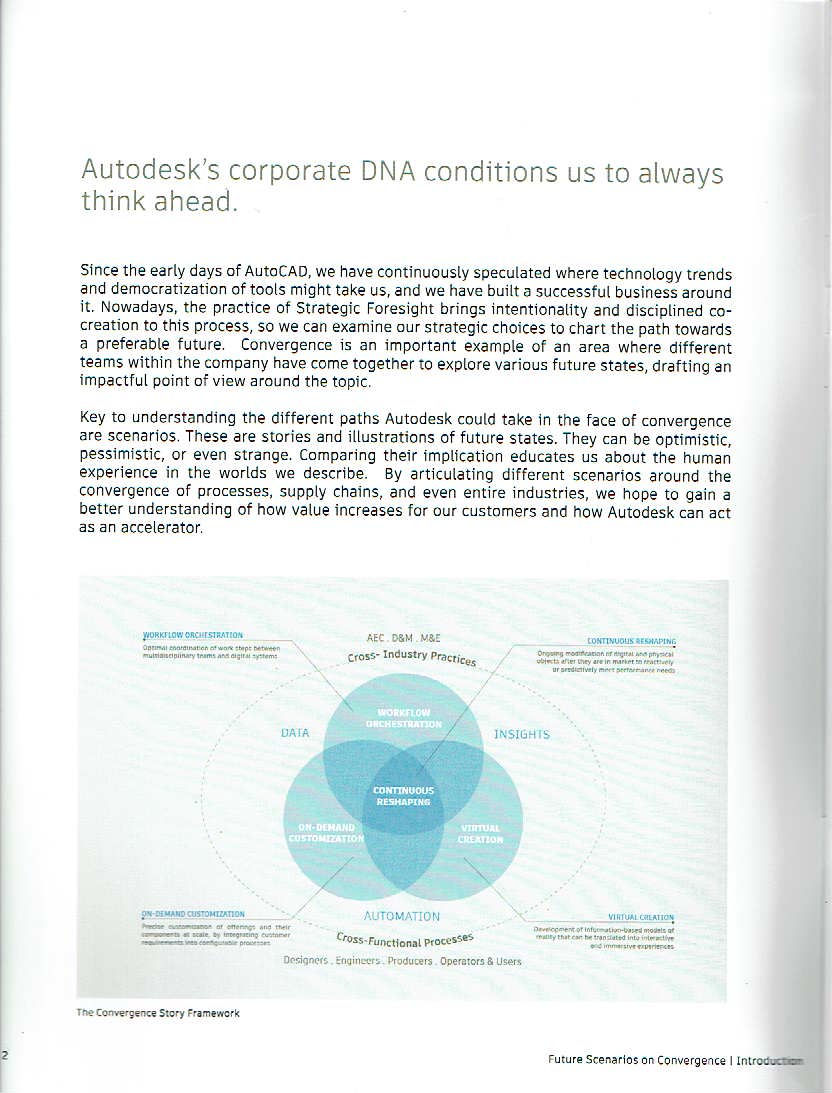
Convergence is an important example of an area where different teams within the company have come together to explore various future states, drafting an impactful point of view around the topic. Key to understanding the different paths Autodesk could take in the face of convergence are scenarios. These are stories and illustrations of future states. They can be optimistic, pessimistic, or even strange. Comparing their implications educates us about the human experience in the worlds we describe.
The scenarios we created this past summer build on the Converging Ways of Making and the foundation of previous work from within Autodesk, such as the Forces of Change and the Sustainability Impact Opportunities.
In working on these narratives, we imagined what would be a preferable future to Autodesk and its customers, as this is the true promise and potential of foresight. We imagine the future we want to have happen and then work to realize that future.
Therefore, in our research, we paid special attention to the trends indicating positive outcomes. For more negative trends, we asked what needed to change to have a different outcome. In the first phase of the scenario building process, we identified potential key trends. This was followed by interviewing experts in the industries Autodesk serves. Autodesk's Global Network, external industry practitioners, and internal Autodesk employees all shared with us their wealth of knowledge, whether in how a specific technology functions or just in the general culture and history of an area relevant to a story setting. We tried to understand what challenges each of these experts faced and what their ideal solutions might be. From the trend research and interviews, we then derived scenario drivers that would shape the narrative. These were ranked based on their importance to Autodesk's customers and by the level of uncertainty we have towards the drivers in the future. Two of the selected five are primary drivers:
1. Change in relationship with the built environment
2. Widespread intelligent co-creation between humans and machines
These drivers determined both axes of a matrix [see matrix above], a device used in foresight to define and clearly situate scenarios in relation to one another, by placing them on the matrix quadrants. The three secondary drivers were also woven into our stories, although not featured on the matrix. 1. Global companies localize manufacturing and distribution for more resilient supply chains 2. Increased implementation of equitable design 3. Sharing insights and skill-sets across all levels of companies' ecosystems This method, used to arrive at the scenarios, was almost equally as important as the stories themselves. By documenting our process, we gave the scenarios more legitimacy, helped the foresight team continue to develop the emerging practice of future thinking, and provided others around Autodesk with examples of human-centric perspectives and foresight methods. The research behind the final three scenarios and the technology involved is what makes them relevant to Autodesk and convergence, but the narrative structure cements the ideas in peoples' minds. Autodesk's visions of potential futures are more accessible and memorable by humanizing technology and contrasting its challenges with characters and personal conflict. Each of these three stories is differentiated by their protagonist, location, the industries in focus, and the year it is set in.
In Auckland, New Zealand, in the year 2025, Taika is a 28-year-old manufacturing technology manager working for Epic Entertainment. After using his pair of Augmented to develop an efficient and sustainable build and reuse cycle for massive set pieces, he struggles to show his boss the benefits of implementing his work.
In Chicago, in the year 2028, Emma, the 35-year-old experience designer, works for the architecture firm NBBJ. She is at odds with her coworkers and fighting with personified machine intelligence named SHEILA over creative control of an interactive hall for a new mixed-use tower.
In Cairo, in the year 2030, Hassan is a 60-year-old construction company owner. Wanting to build a self-regulating development of middle-class homes, he tries to learn from his architect daughter and his head of crew how to balance the offerings of an advanced digital twin with his crew's expertise.
We hope that these scenarios demonstrate the meaning and potential of convergence both inside and outside of Autodesk. But the work should not stop here. Contrasting the scenarios could help inform Autodesk about which aspects of the imagined world represent opportunities, and what it would take to get there. These stories can convince the company to overcome lengthy analysis, move faster and more intentional into the future, driven by both the promise and inevitability of convergence. The fictional characters and their imagined struggles are intended to place those at Autodesk in their customer's shoes, seeing the kinds of problems they might face, and the solutions they might need.
Presented to customers, speculative scenarios allow practitioners to see Autodesk's point of view, and ultimately work towards a preferable future in the face of convergence themselves.
Envisioning futures through relatable scenarios is helpful, but if Autodesk wants to maintain its position as a thought leader, it must show its customers that it can work with them to produce the tools and technology that make any of these futures possible. Such work is often rooted in innovation that began as speculation.
Sample Visuals from Scenarios and Presentation


Read Full Scenarios Here: Scanned from Printed and Distributed Version